
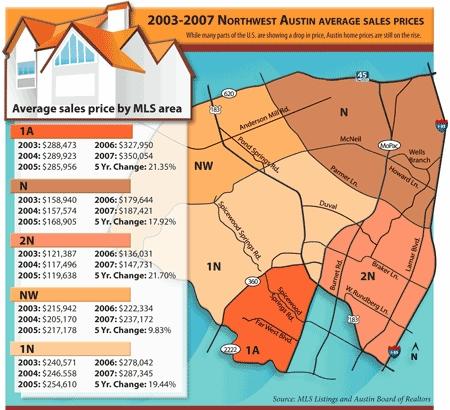
In Northwest Austin, the number of homes sold in January was down 17 from the previous year, a 15 percent decrease, while Austin had a 12 percent decrease and Texas had a 14 percent decrease.
While this means fewer sales for realtors, it could be a good thing for those looking to buy a house. However, just because numbers of sales are down does not necessarily mean that prices are going down.
Price is steady
"The market's slowed down slightly this year," Austin realtor Eric Bramlett said. "We haven't seen the same activity (as in previous years), but we haven't really seen a decrease in prices. We've seen a decrease in sales volume. I think that more than anything, it has to do with the mortgage market. There are less buyers able to purchase right now."
One of the reasons there are fewer buyers in the market is because loans, especially for first-time buyers have become harder to get.
"We've had some major changes on the lending side that have had a huge impact on borrowers being able to get financing," said Gray Buffington, president of Buffington Mortgage, a mortgage company in Northwest Austin. "Zero down loans, which are typically for first-time home buyers, are harder to obtain. They're still able to get them, but the credit thresholds have been raised, and so borrowers that were buying in those areas with marginal credit now are unable to buy and are moving back into apartments."
Buffington said that within Austin, he has not seen a difference in the real estate market, but that outlying areas of Cedar Park and Pflugerville, where there is still room for development, are seeing some slow down, because homes for resale are having to compete with new homes being built.
While it is more difficult for many first-time homebuyers to get loans, those that are doing well financially may have more bargaining power than in previous years with less competition for homes on the market.
Housing Predictor, which provides independent real estate market forecasts online for more than 250 cities in all 50 states, named Austin the tenth hottest buyer's market in the U.S. for 2008.
"Our business has been very steady, but we've seen a little pressure on price," said Northwest Austin realtor Jim Morelli of Re-Max Capitol City.
Affordability
The median family income has not increased substantially since 2001 according to HousingWorks Austin's website. HousingWorks Austin is a nonprofit organization aiming to keep homes affordable for Austinites through research, education and public policy change.Despite Austinites living roughly on the same income, Austin housing prices continue to rise.
A forecast by the National Association of Real Estate said the Texas market is still experiencing gains in home prices, with Austin having a price increase of 6 percent in the final quarter of 2007.
Despite most metropolitan areas' housing being overvalued, Austinites might be surprised to find Austin housing, along with many Texas cities, was found to be undervalued by 9.1 percent in a recent report by Global Insight.
Permits
According to data from the Austin Chamber of Commerce, new privately-owned housing units authorized by building permits decreased in 2007 by 6,152 with the largest decrease in single family homes.
James Pratt, owner of Custom Electronics in North Austin, a business that works with homebuilders to engineer, design, and install electronic systems in residences and professional offices said that he hasn't seen much of a decline in construction this past year except in lower-end homes.
"The biggest change we've seen is kind of in the lower-end market: $100,000 to $200,000 homes," Pratt said. "We've seen that market kind of drop off. They're not building as many houses. In the construction portion the market downturn hasn't affected Austin as much as some of the other parts of the nation. The lower-priced house, I think it's harder for people to get into those loans now, and I think that's affected building."
Incentives to buy
In January, U.S. Sen. John Cornyn co-sponsored a bill that, if passed, would give a $15,000 tax credit distributed over three years to homebuyers that buy a new, foreclosed or under pending foreclosure home. A similar incentive was used in the 1970s to boost the market when it was lagging.
"I think the national media are having a psychological effect on some of the buyers in the market," Buffington said. "They don't understand that the market here in Austin is still very strong. Really, with the exception of some tightening of some lending guidelines, the Austin market still remains very strong and we're running counter to the rest of the nation. We have one of the strongest markets in the country."
*Global Insight is the world's leading company for economic and financial analysis and forecasting. The study, which uses household population density, mortgage interest rates, relative income levels and characteristics unique to the history of each metro area for its analysis warns that data should not be misinterpreted by reading too much into the analysis. The study has a standard deviation in house price valuations of plus or minus 15 percent, so any valuation between 15 percent overvalued and 15 percent undervalued should be considered statistically normal.